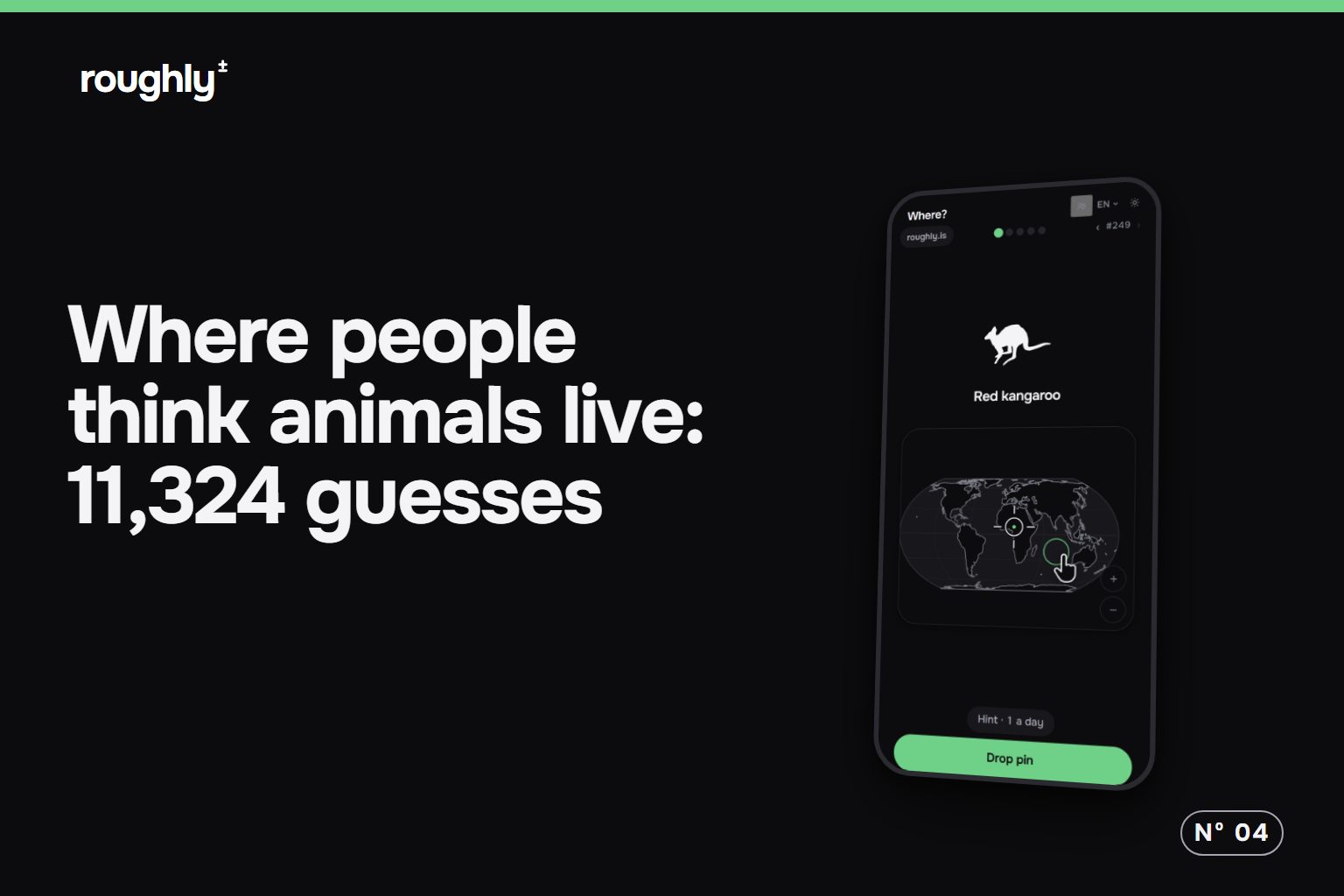
Every day, Where? shows five animals and you drop a pin where you think they live. Since 18 September the game has kept every pin. That's 11,324 guesses from 1,933 devices, spread over 81 animals. I wanted to know which ones fool people, and whether the mistakes have a pattern.
Most misses are near misses, a few are on the wrong continent
Across all 81 animals, 23 percent of pins landed inside the real range. The median miss was 1,412 km. That sounds bad until you remember a pin one country over counts as a miss too.
Some animals are easy. The South American tapir got 78 percent of pins inside its range, the American alligator 72 percent, the moose 70 percent. Big range, famous home, no trick in the name.
Then there are the five below. For each one, a single wrong place collected a big share of all pins:
That's the pattern: the wrong place is never random. It's the place the name or the picture suggests.
The wrong place is the one the name points to
The manatee is the clearest case. "West Indian" means the West Indies, the old name for the Caribbean islands. Read fast, it means India.
The Humboldt penguin is the reverse. The name says nothing, so people fall back on the picture of a penguin on ice. 103 of 171 pins went to Antarctica, another 14 to southern Africa, where a different penguin lives. Not one pin landed on its coast in Peru and Chile. It is a warm-water bird, fed by the cold Humboldt Current.
The other three are harder to explain, and I don't want to invent a reason. The naked mole-rat lives in the dry east of Africa, in Kenya, Ethiopia and Somalia; 105 of 278 pins went to North America. The spectacled bear is the only bear in South America; 105 of 285 went to North America anyway, maybe because that's where bears are supposed to be. The olm is a blind salamander from the caves of the Balkans; 113 of 365 pins went to the Americas. A guess: people confuse it with the axolotl from Mexico. I can't prove that from pins alone.
These are roughly players, not everyone
The obvious objection: this is a small, self-selected crowd. People who play a daily guessing game at breakfast are not a sample of humanity. Most animals ran on a single day, so one day's crowd decides its number.
That's true, and it's why I only report counts and shares, never "people think". But the pattern holds across very different animals and very different days, and the wrong places line up with the names. A bias that strong is unlikely to vanish with a bigger crowd.
One more limit: a pin inside the range counts as 0 km, so animals with huge ranges look easy and animals with narrow coastal ranges look hard. That's why the list above uses one wrong place instead of distance.
What to take from it
Next time an animal name contains a place, check whether the place is real. "West Indian" is the Caribbean, "Guinea pig" is from South America, not Guinea. If you want to test yourself, today's Where? round takes a minute, and the reveal tells you how far off you were. If you like dailies that aren't about words, the Amountle post is a good next one, and the about page explains where roughly's numbers come from.
Five animals a day, one pin each, and a map that tells you the truth.
Play today's Where?