
Most murder-mystery games are reading games. You collect statements, someone slips, the plot carries you to the end. Suspectle drops almost all of the plot and keeps the logic. The first two minutes are harder for it. After that, every step is one you can check.
Suspectle turns a murder into a seating plan
Today's case, Frost on the Radio Set, is a research station cut off by sea ice. The relief flight is six weeks out. Six people were inside, one of them is dead, and the floor plan is a 6×6 grid.
The rules fit in two lines. Every person stands in their own row and their own column. Squares with furniture are taken, and whoever ends up alone in a room with the victim did it.
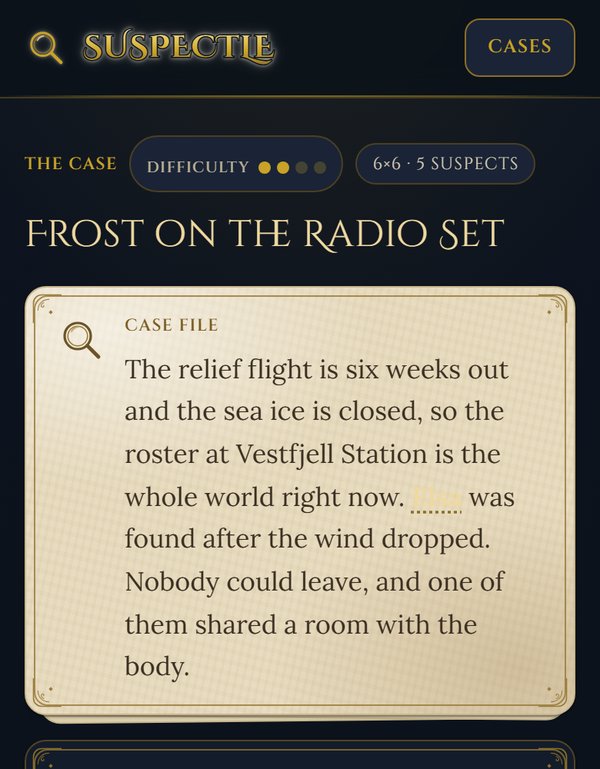
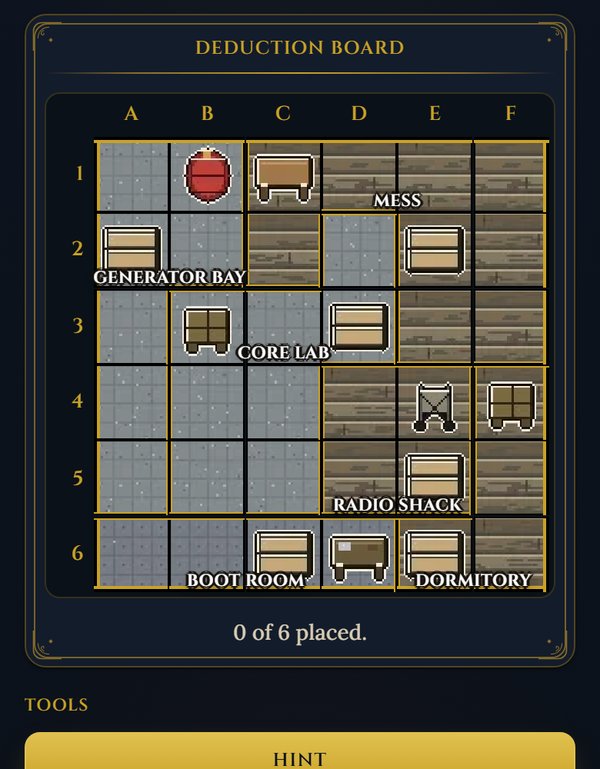
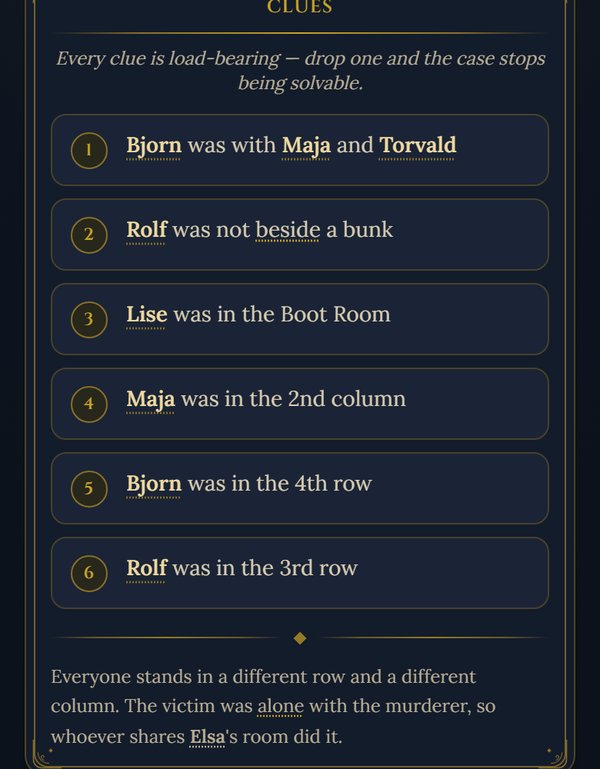
The clues are plain. Lise was in the Boot Room. Maja was in the 2nd column. Bjorn was in the 4th row. The page says every clue is needed: take one away and the case can't be solved. Every case is checked to be solvable by reasoning alone, so when you're stuck, you missed something. The game didn't hide it.
The daily floor plan is one of four case types, with 56 cases and four difficulty levels in total:
- Floor-plan cases: place every suspect from the clues.
- Break the story: take a five-part statement apart, piece by piece.
- Sort the evidence: group sixteen pieces by who they point to.
- Piece the scene: rebuild the evidence from row and column counts.
PuzzleBeat is the warm-up, not the main course
PuzzleBeat comes from the same maker and has a different mood. Six puzzles, a new set at midnight Eastern Time, each one a few minutes long:
- Lights Out (logic): tap a light to flip it and its neighbours until all are off.
- Pipe Connect (spatial): turn pipes until water runs from source to drain.
- Nonogram (logic): use the number clues to fill the grid and reveal a picture.
- Arrow Out (logic): slide every arrow off the board, only when its path is clear.
- Jigsaw (spatial): snap today's picture together against the clock.
- Beat Match (memory): repeat a light pattern that grows by one step each round.
That means three of the six are logic, two are spatial and one is memory. Suspectle is the long think, PuzzleBeat is the short one.

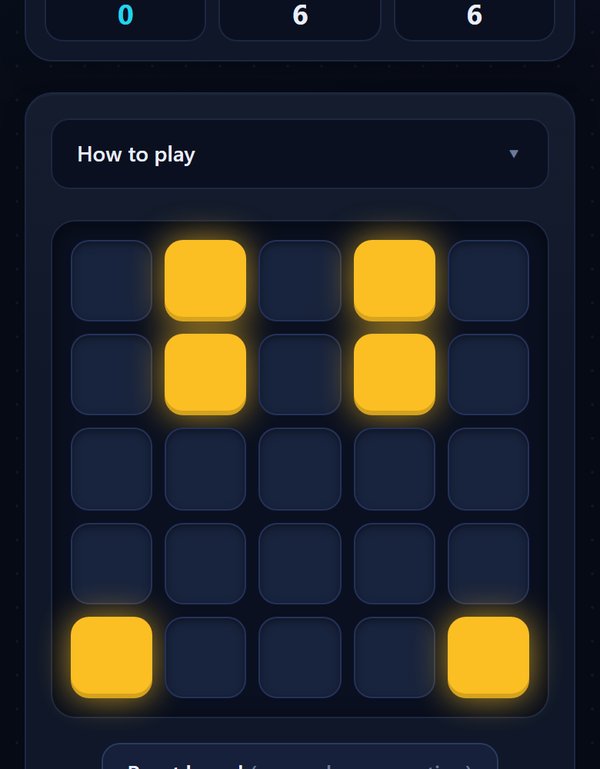
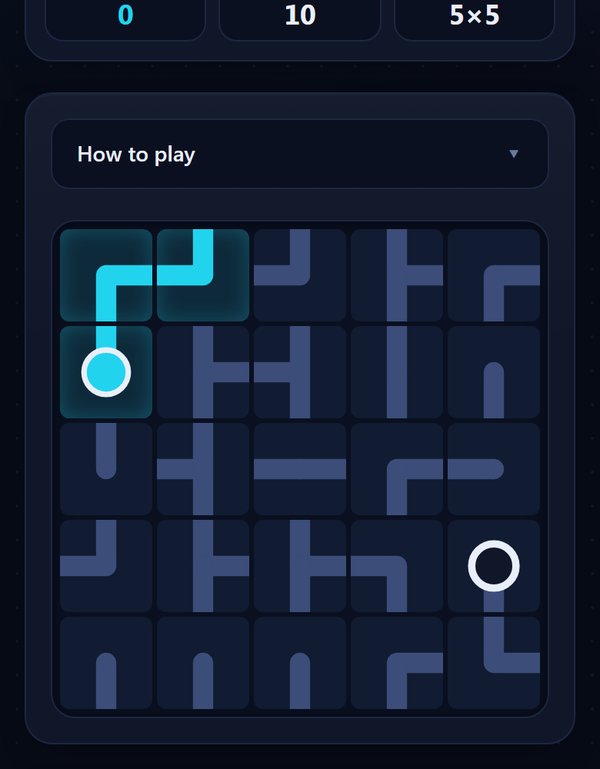
Missed a day? Every past set is in the archive. There's also a jigsaw gallery where you can upload your own photo and turn it into a puzzle.
Yes, we link to each other
roughly is my own set of estimation games, and since this week Mark LaPorte, who makes both sites, lists roughly on his Good Company pages. His games are on our supporters page in return. So read this with that in mind.
Nobody paid for this post, and every fact in it comes from his own pages or from today's case. The games also ask different things. roughly wants you to estimate what you can't see: how big, how far, what year. Suspectle hands you everything and asks you to reason. When we set up the swap, Mark suggested starting with Suspectle for exactly that reason, because it's the closer kind of thinking. I build roughly alone from Switzerland, and I like finding other daily sites that work without a login and still feel finished.
Skip it if you want to be told a story
If you want dialogue, twists and a confession scene, Suspectle will feel dry. And if you want words or trivia, neither site has them.
Otherwise, play today's case once. Start with the strongest clue, the one that fixes a row or a column, and let the rest follow. If it clicks, PuzzleBeat's six are the quick round for the next morning. More daily games without words are in this list of fourteen I checked, and Amountle is another one-person daily worth a look.
One case a day, six clues, no guessing.
Play today's Suspectle case