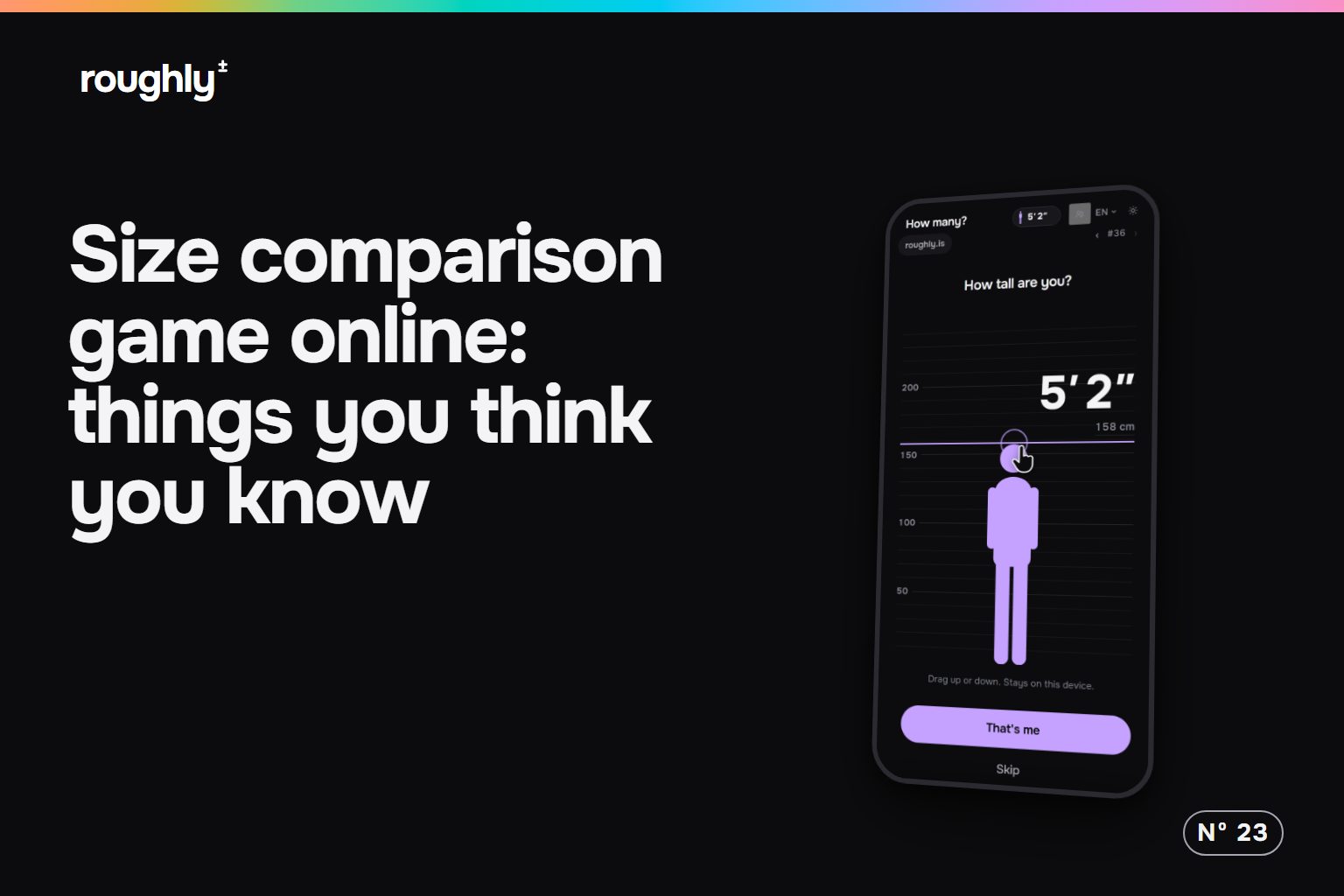
Most people think they know how big a rocket or an airship is. Then they have to show it, and the guess comes out far off. The knowledge was never the problem. The missing piece was a second object to measure against.
A size only lands once it has a neighbour
The Saturn V rocket stood 111 metres tall. Few people can picture 111 metres. Lay the rocket along a 105 metre football pitch and it covers the pitch end to end with metres to spare. That is the anchor the How big? reveal hands out for this rocket.
The table puts five tall or long things against the same pitch. None of them needs a new number, only the old one counted again.
| Thing | Length or height | In football pitches of 105 m |
|---|---|---|
| Big Ben | 96 m | just under 1 |
| Saturn V | 111 m | just over 1 |
| Hindenburg | 245 m | about 2.3 |
| Titanic | 269 m | about 2.6 |
| Eiffel Tower | 330 m | about 3.1 |
That means one familiar shape is enough to order all five. The pitch does the work a ruler would do, and you already carry it in your head.
The game has to keep the ruler fixed
Once there is a neighbour, it must not move. In How big? the left shape is named and stays the same size. It is your only ruler. You pull the right one up or down until it looks right beside it, then lock it in. The miss comes back as a factor: half the real size reads 2x too small, anything inside 1.05x counts as spot on.
How wide? does the same with cities. Two real cities sit on one grid, one fixed, one yours to size. The reveal shows the continuous built-up area from satellite measurements of the Global Human Settlement Layer, not the administrative border. Tokyo's built-up surface runs on through Yokohama and Kawasaki to 10,168 km², five and a half times Paris.
How big? also runs live in a room with friends: the same five rounds for everyone at once, answers shown together.
A neighbour can mislead as well
The fair objection: a reference can pull a guess the wrong way. When players had to size the Hindenburg next to a 4.5 metre Greenland shark, 181 of 184 made it too short. The typical guess was 46 metres, about a fifth of the real ship. The full numbers are in the post on how players guessed the Hindenburg five times too small.
That supports the point rather than breaking it. A shark is about 50 times shorter than the airship, so nobody can count it into the answer. The useful neighbour is one close in size: the Hindenburg was longer than three Boeing 747s nose to tail and only 24 metres shorter than the Titanic. Put either next to it and 46 metres is no longer possible.
Comparison fails when both things are strangers
If you have never stood next to either object, the pair gives you nothing to count. A deep-sea fish beside an unknown satellite is still two guesses.
Next time a size comes up, name the thing that would stand next to it before you name a number. A pitch, a bus, a tower, your own height. Players get the same kind of thing wrong about where animals live, as 11,324 guesses on animal ranges show, and Amountle tests it with a pile you can see. More dailies without words are in this list of fourteen.
One known shape, one you pull to size, five rounds a day.
Play today's How big?Sources 5
- Wikipedia: Saturn V - height of the rocket with the Apollo spacecraft on top
- Wikipedia: Eiffel Tower - height to the tip
- Wikipedia: Titanic - length of the ship
- Smithsonian National Air and Space Museum: Following the Hindenburg - the Hindenburg as the longest aircraft of any type
- Global Human Settlement Layer, European Commission JRC - satellite measurements of built-up surface behind the city sizes