That is not how odds are usually taught. A school exercise gives one event and asks for one fraction. Real life hands you a headline that says "rare" and no second number. Without a comparison, 1 in 10,000 and 1 in 10 million feel the same, and they are a factor of a thousand apart.
A probability makes sense only next to another one
The US National Weather Service puts the chance of being struck by lightning over an 80-year lifetime at about 1 in 15,300. A royal flush is 1 in 649,740 five-card hands.
The table sets five real events on one line. Each comes from a primary source or from the rules of the game.
| Event | Real odds |
|---|---|
| Double six with two dice | 1 in 36 |
| Struck by lightning, US lifetime | 1 in 15,300 |
| Royal flush, one hand | 1 in 649,740 |
| Hurt by a grizzly, per Yellowstone visit | 1 in 3.3 million |
| A 10 km asteroid hits Earth, this year | 1 in 100 million |
That means each line explains the one below it. Once a royal flush has a place on the scale, a grizzly at five times rarer has one too. The odds stop being separate facts and become a ladder.
Real odds need a scale in powers of ten
The ladder above runs from 1 in 36 to 1 in 100 million, more than six orders of magnitude. A linear slider cannot hold that. So the useful question is not the digits but which power of ten you are in.
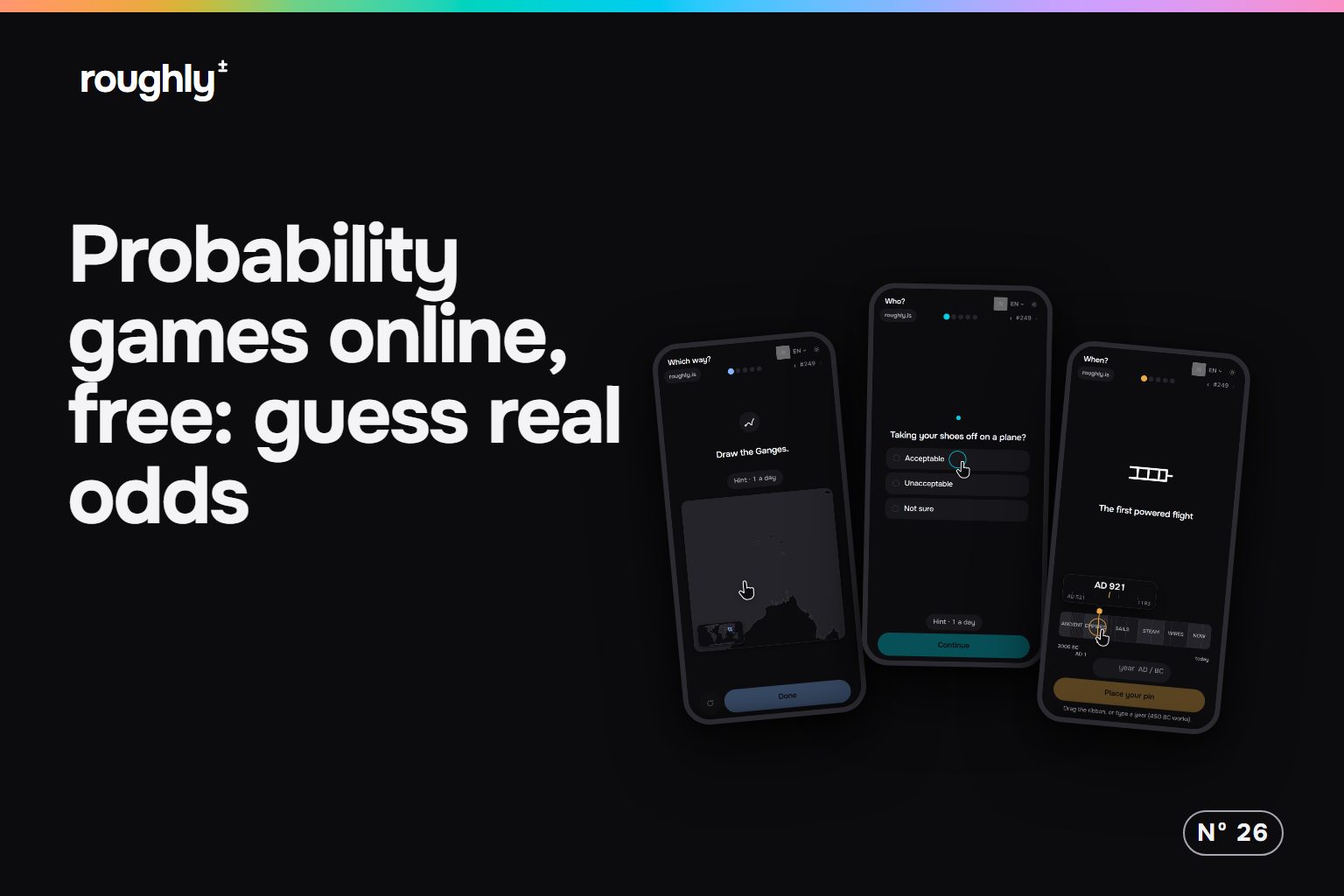
How likely? is built on that. Every round names one real event and what it is counted against: people, throws, park visits, years. You drag a scale from 1 to 1 billion, and a field fills with that many dots around one red dot, with rings where 1,000 and 10,000 end. Lock it in and the real odds appear with their source. The miss stands there as a factor: guess 1 in 100 when the truth is 1 in 1,000 and the sheet reads 10x too common.
It is free, needs no account, and has five new rounds a day, the same for everyone. It also runs in a live room, so a group guesses the same odds at once.
Average odds are not your odds
The fair objection: a national figure hides your own risk. Someone who works outdoors in a storm belt does not share the average lightning chance of a person in an office.
True, and that is why the base has to stay visible. The lightning round shows its working: about 270 people a year killed or injured in the US from 2009 to 2018, out of 330 million, so 1 in 1.22 million per year, and about 1 in 15,300 over 80 years. With the count and the population in view, you can move your own case up or down from there. A bare "rare" gives you nothing to move.
Dice and cards need no guessing
For games of chance, the rules give exact odds, so estimation adds nothing: a double six is 1 in 36 by counting.
The practice pays off on events that are counted in the real world. Next time a headline says something is rare, ask one in how many, and counted against what. Then place it next to an odds figure you already know. The launch post for How likely? explains how its archive works. The same pull to misjudge shows up with sizes, where players guessed the Hindenburg five times too small, and with dates, where players put the Bronze Age 1,500 years too late. Amountle tests counting what you can see.
Five real odds a day, each with its source and your miss as a factor.
Play today's How likely?Sources 4
- NOAA National Weather Service: How dangerous is lightning? - lifetime and yearly odds of being struck in the US
- Wolfram MathWorld: Poker - number of five-card hands and royal flushes
- US National Park Service: Yellowstone bear management - grizzly injuries per park visit
- NASA Science: Asteroid facts - how often a 10 km asteroid hits Earth