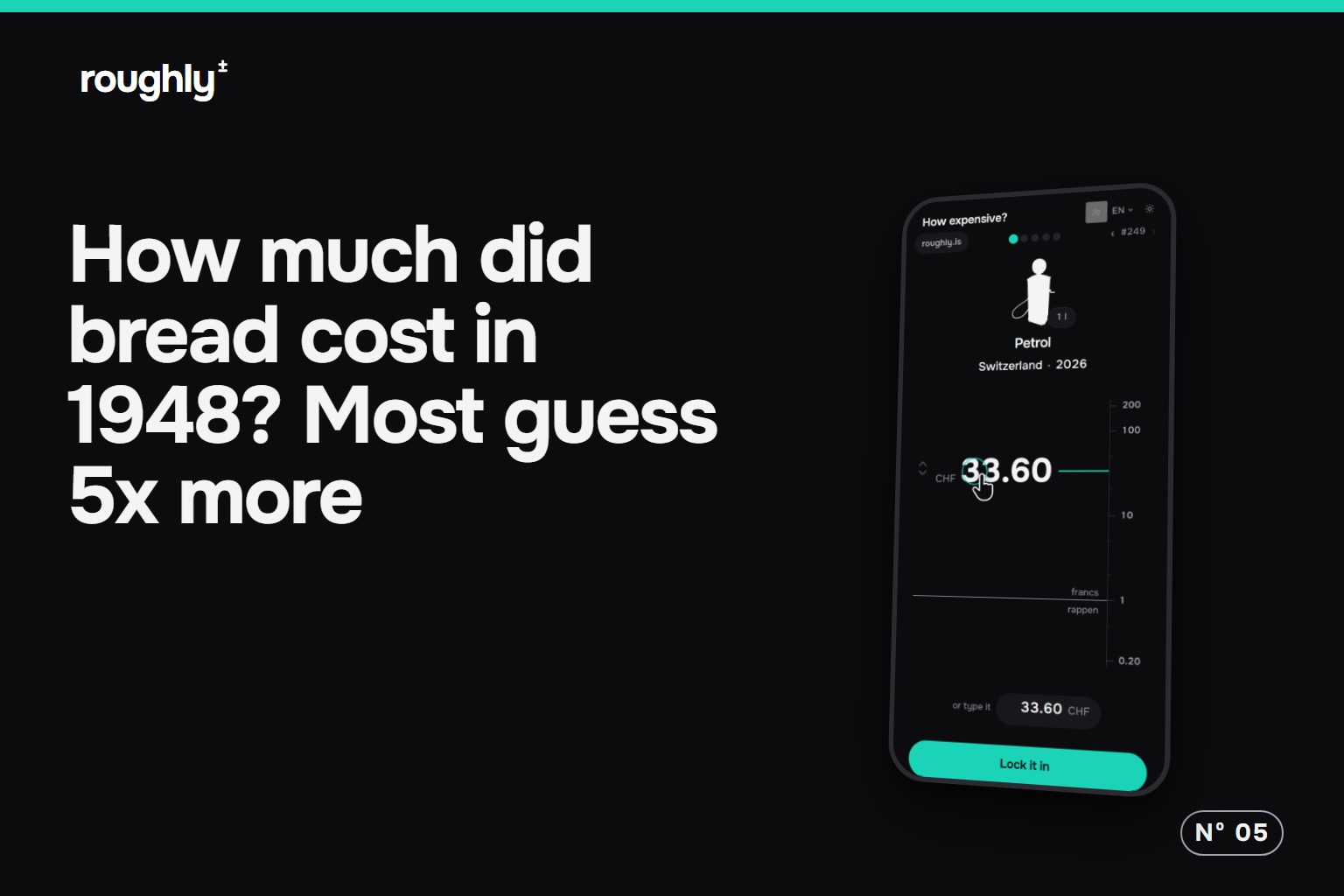
How expensive? asks one price a day: a litre of milk in Zurich today, a kilo of sugar in 1930, a loaf in 1948. You set your guess, then see the real number with its source. By 26 September the game had 4,226 daily guesses on 89 items, and the misses have a direction.
Today's prices are a coin flip, old prices are not
On the 56 items priced today, players missed high 1,154 times and low 1,193 times. That's as close to even as it gets. The typical miss was still about 2.2 times off, so nobody is a price oracle, but the errors cancel out.
On the 33 historical items, the picture flips. 1,022 misses were too high and 360 too low: 74 percent of the misses on old prices landed above the truth, and the typical miss grew to about 4.5 times.
Five items, five decades, the same result: two thirds or more of all guesses were at least five times the real price.
The misses come from underestimating how far prices moved
The real numbers are small because prices then were small. A 1970 sliced loaf cost 9 pence, today the same loaf costs well over a pound. A kilo of sugar in 1930 was 2.5 pence. When people guess, they seem to start from today's price and shave a bit off. They take off too little.
That's the interesting part. People know prices went up. They just don't feel how much. Seventy-five years of inflation is a factor most of us have never had to picture, so the guess lands somewhere between the past and the present.
Old pence make it harder, but they don't explain it
The fair objection: British money changed in 1971. Before that, a pound had 240 old pence, and the game shows old prices in today's decimal pence. The 1948 loaf was about 4.5 old pence, which the game shows as 1.9. A player thinking in old pence would guess too high.
That's real, and it will explain some of the misses. But the 1970 and 1955 items show the same pattern as 1930, and even a player thinking in old pence would land at most 2.4 times too high. Most misses here were five times or more. The money change makes it harder, it doesn't make it disappear.
These are also roughly players, not everyone, and each item ran on one or two days. I report counts, not a law about people.
Try it on the next old price you see
When a film or a book mentions an old price, guess it before you read it. Most of us will guess too high, and that small surprise is a better sense of history than a date. If you want to practise, How expensive? has one price a day. For another look at what roughly players get wrong, read where people think animals live, and if you like dailies that aren't about words, the Amountle post is a good next one.
One price a day, then the real number and its source.
Play today's How expensive?