Most chat games work the other way round. The streamer plays, chat backseats, and a few fast typists steer the run. Delay makes it harder: Twitch writes that its low-latency streaming cut the gap from creator to viewer from over 30 seconds to a few seconds, and a few seconds still decide a timed answer. The real question is how chat gets its own turn without installing anything.
A shared round turns every viewer into a player
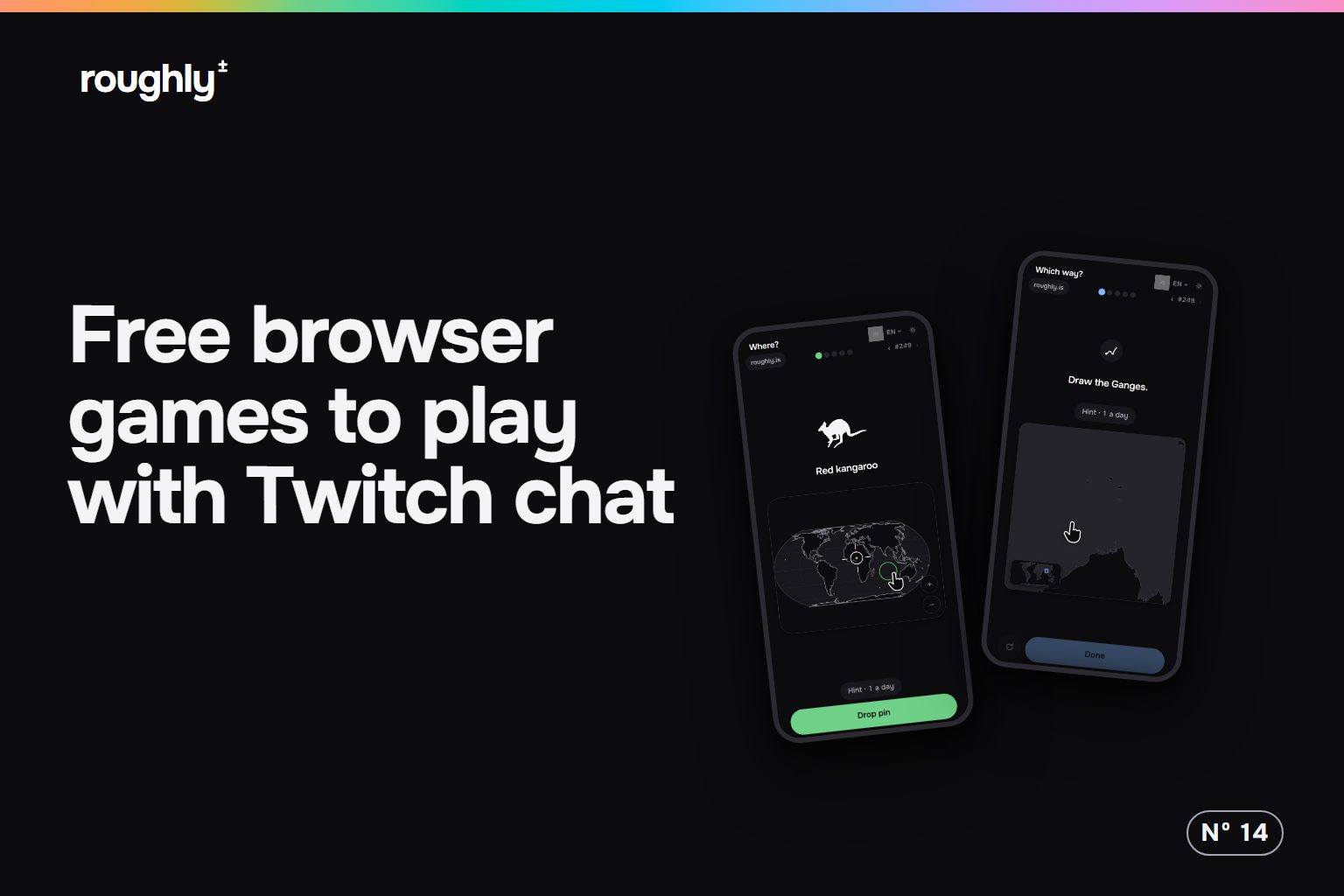
In a roughly room, chat joins at roughly.is/r with a four-letter code and a name. No app, no account. Everyone answers the same question on their own phone, and every guess lands on one screen.
That changes what the stream shows. In Where?, the question names an animal, the pins from chat gather on one map, and then the real range appears with each player's distance. A map full of chat pins explains itself on screen, which is why the streamer page suggests starting there. Every guess is a distance, so someone in chat is usually closer than the streamer, and the room shows who.
The reveal waits for chat, not for the stream
A shared round only works if the answer does not show up before the guesses are in. A room for streamers is built around that, with the settings below.
| Setting | What it does |
|---|---|
| For streamers | The room code stays hidden on screen until you show it |
| Reveal | Set to "I decide": the answer appears when chat has locked in |
| Time per round | 15, 30 or 45 seconds, or any number from 10 to 300 |
| Names | Slurs and the worst words are blocked; you can kick anyone |
| Next game | After five rounds, pick another game with the same code |
That means the delay from the top of this post stops mattering. The round ends when chat is done, whatever latency a viewer has, and the streamer can force the reveal or the next round at any time. Seven of the games run in a room, among them Where?, How big?, When? and How likely?.
Chat can google the answer, and it rarely helps
The honest objection: a viewer can look things up. Some will. But a default round lasts 15 to 45 seconds, and in Where? the answer is a pin on a map with no labels and no borders. Reading that an animal lives in central South America still leaves placing the pin, and the score is the distance to the real range.
The numbers suggest most players guess rather than search. When players of How big? had to draw a Falcon 9, a rocket about 70 m tall, the typical answer was 194 m, as the Falcon 9 analysis shows. Misses like that are what a reveal on stream is for: the whole chat sees how far off it was, together.
A guessing round does not fit every stream
If people come for a long run of your main game, a five-round break interrupts more than it adds. Which way?, Who?, How sweet? and How wide? stay single-player and do not open in a room.
For the next stream: open a room before going live, switch on "for streamers", add your channel and pick Where?. Show the code when you are ready, let chat lock in, reveal when the guesses stop. After five rounds the same code takes everyone to the next game. It also works on YouTube or Kick, anywhere you can show a code, and for more dailies after the stream there is a list of games like Wordle but not words.
One code on screen, the whole chat guessing the same round, free for everyone.
Play with your Twitch chatSources 1
- Twitch Blog: ACM MMSys 2020 Grand Challenge - Twitch on its low-latency streaming since 2017 and why chat needs near real-time video