The suffix says less than it seems. Some -dle games keep Wordle's letters, most drop them, and a few keep nothing but the daily rhythm. So the name tells you the format, not the game. The question worth asking about any -dle is what it makes you guess.
The -dle comes from a word game that became a format
Wordle gives players six tries to guess a five-letter mystery word. That is how The New York Times described it when it bought the game on 31 January 2022. Josh Wardle, a software engineer in Brooklyn, had released it to the public in October 2021.
What other makers copied was the format, not the word game. They kept the rhythm and swapped the subject. Worldle asks for a country or territory from its silhouette, with six tries and a new puzzle every day. Framed asks for the daily film from six frames. Neither has anything to do with letters, and both carry the name.
people played Wordle, nearly two months after 90 did
90 players on 1 November 2021, 300,000 nearly two months later, millions a day by the sale.
Quelle: The New York Times CompanyThat is why -dle turned into a word for the format: by early 2022, a daily puzzle that everyone shares was something millions of people recognised on sight.
The family splits by what you guess, not by the name
Once the subject is free, two -dle games can share a name ending and nothing else. The useful way to sort them is the answer they want.
| Game | You guess | The answer is |
|---|---|---|
| Wordle | A five-letter word | Right or wrong, six tries |
| Worldle | A country or territory from its shape | Right or wrong, six tries |
| Framed | A film from six frames | Right or wrong |
| roughly | A size, a place, a year, the odds | A distance from the truth |
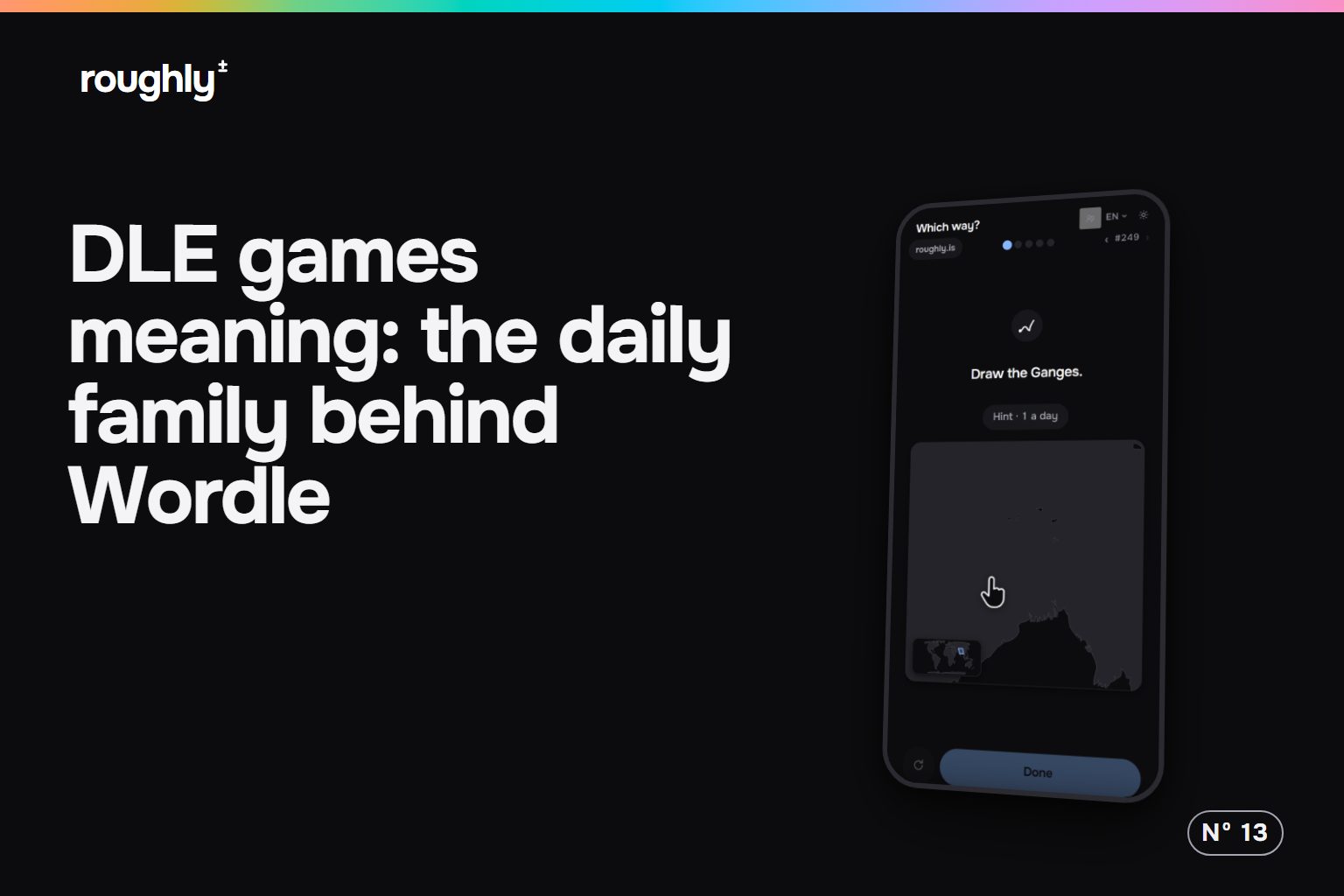
So the real split is between right-or-wrong puzzles and how-far-off puzzles. In roughly's Where?, the miss is in kilometres; in How big?, it is a factor like 2.5x too small; in When?, it is a number of years with a direction.
roughly has no -dle in its name, and still belongs
The fair objection: if the suffix defines the family, a game called roughly sits outside it. The suffix does not define it. The skeleton does, and roughly has the whole skeleton: five rounds a day in each game, the same five for everyone, new rounds at midnight UTC, and a result card that holds your five distances and none of the answers. The list of games like Wordle but not words puts it next to the other dailies where the answer is a number.
The name does not tell you everything
If you want letters, the -dle label is no guarantee: most of the family dropped them, and roughly has no word game at all. The name also says nothing about whether a game still runs, so check the page before you share it.
When a friend sends a -dle link, ask what it makes you guess. A word, a country or a film means a right-or-wrong puzzle. If you would rather guess a size, a place or a year and see how far off you were, start with today's mix on the roughly home page, and read who makes roughly and where its numbers come from.
A daily game with places instead of letters: five animals, one empty map.
Play today's Where?Sources 3
- The New York Times Company: Wordle Is Joining The New York Times Games - Wordle's rules, its creator, its public release and its early player numbers
- Worldle - daily game: guess the country or territory from its silhouette in six tries
- Framed - daily game: guess the film from six frames