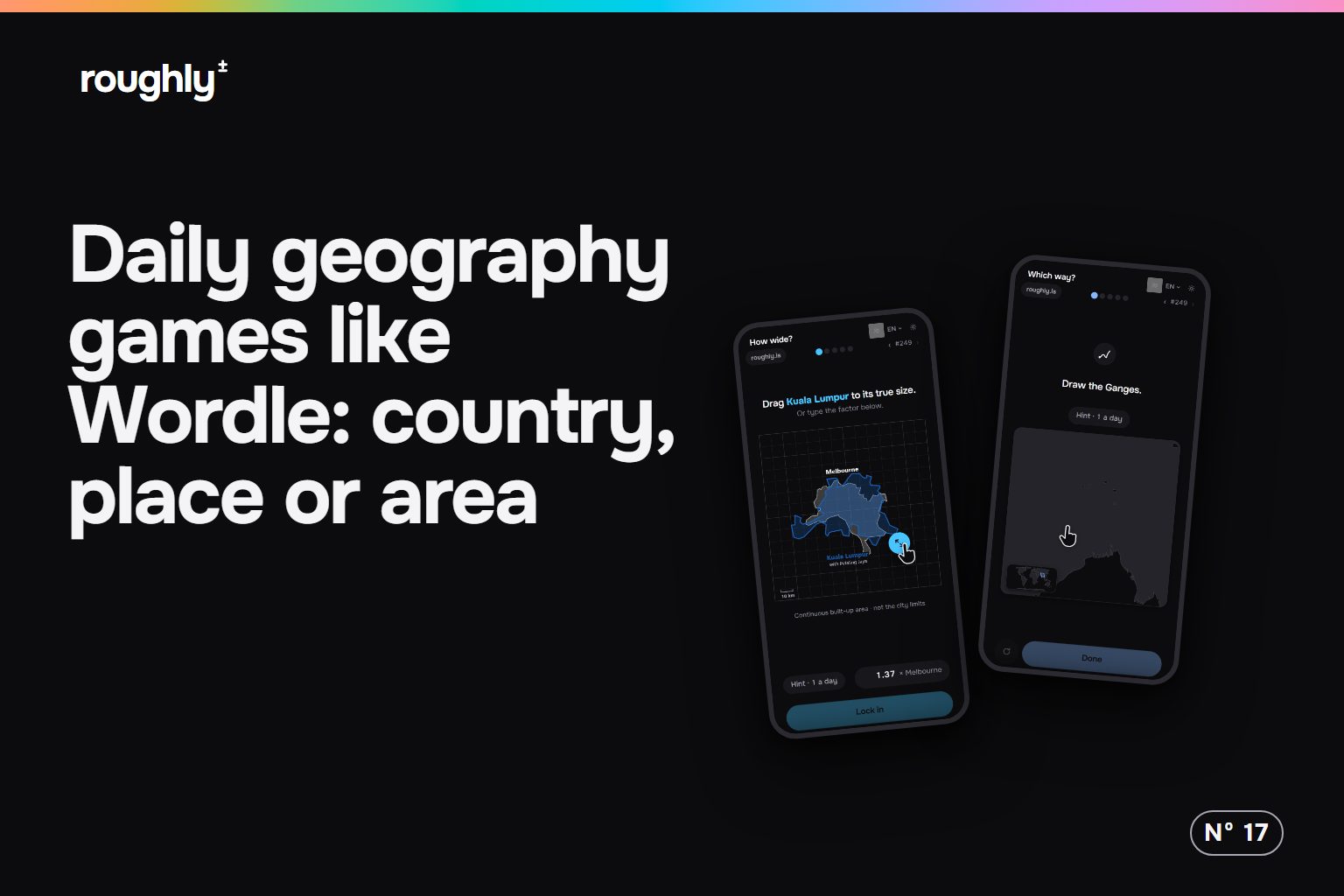
On a list they all look alike. One puzzle a day, the same for everybody, a result you can paste into a group chat. The games like Wordle but not words post opened a row of them and found four map games side by side. But typing a country name and dropping a pin are different skills. One rewards a list in your head. The other rewards a picture of the map.
The answer type decides what you practise
Worldle hands you a country shape and six attempts, and each wrong guess comes back with a distance and a direction. You still answer with a name.
| Game | What you guess | What you answer with |
|---|---|---|
| Worldle | the country from its shape, 6 attempts | a country name |
| Globle | the mystery country; each guess is coloured hotter as you get closer | a country name |
| Travle | a way between two countries in as few guesses as possible | a chain of countries |
| Tradle | the place from what it exports | a country or region |
| Where? | where an animal lives | one pin; the answer is a whole region |
| Where from? | where a company has its headquarters, from its logo | one pin; the answer is a city |
| Which way? | the course of a river or a mountain range | one stroke drawn on the map |
| How wide? | the built-up area of a city next to another one | a size, as a factor |
That means the first four train names and neighbours, and the last four train positions and shapes. Worldle, Globle, Travle and Tradle get easier as your country list grows. Where?, Where from? and Which way? get easier as your mental map sharpens, and none of them asks you to spell anything.
An area answer changes how a miss feels
In a name game, a wrong guess is a step toward the answer. In a pin game, it is a distance that stays on the sheet. Where? measures from your pin to the nearest edge of the real range, in kilometres, and a pin anywhere inside counts as spot on. Big ranges forgive you, narrow coastlines do not.
The pins show where people go wrong. In roughly's look at where people think animals live, 23 percent of 11,324 pins landed inside the real range and the median miss was 1,412 km. Most misses were a country off. The big ones followed the name: 195 of 293 guesses for the West Indian manatee landed between the Arabian Sea and the Bay of Bengal. It lives in the Caribbean. A name game would have told you "wrong country" and moved on. A pin game shows you the ocean you picked.
Sharing works, even without a coloured grid
The fair objection: half the fun of Wordle is the grid you paste into the chat, and a pin is hard to paste.
The share card solves it without the map. In Where?, the card holds your five distances and none of the answers, so nothing is spoiled. In Which way?, it lists the five names with how far you were off and your typical miss. A friend sees how far off you were and still has to play the round to find out why.
Pin games will not teach you country names
If the goal is to learn the names of countries, a name game is the better daily. An empty map never asks you to type one.
So run one of each for a week: Worldle or Globle for the names, Where? or Which way? for the map. Keep the one you open first in the morning. If you want a number instead of a place, Amountle counts what lands in a glass, and How likely? asks for odds.
Five animals a day, one pin each, no country names.
Play today's Where?Sources 7
- Worldle - guess the country from its shape, six attempts, distance and direction after each guess
- Globle - a daily mystery country, guesses coloured hotter the closer they are
- Travle - get between two countries in as few guesses as possible
- Tradle, OEC - guess the place from what it exports
- Where people think animals live - share of pins inside the range, median miss, the manatee pins
- Where? on roughly - scoring to the nearest edge of the range, share card without answers
- Which way? on roughly - drawing rivers and ranges, share card contents