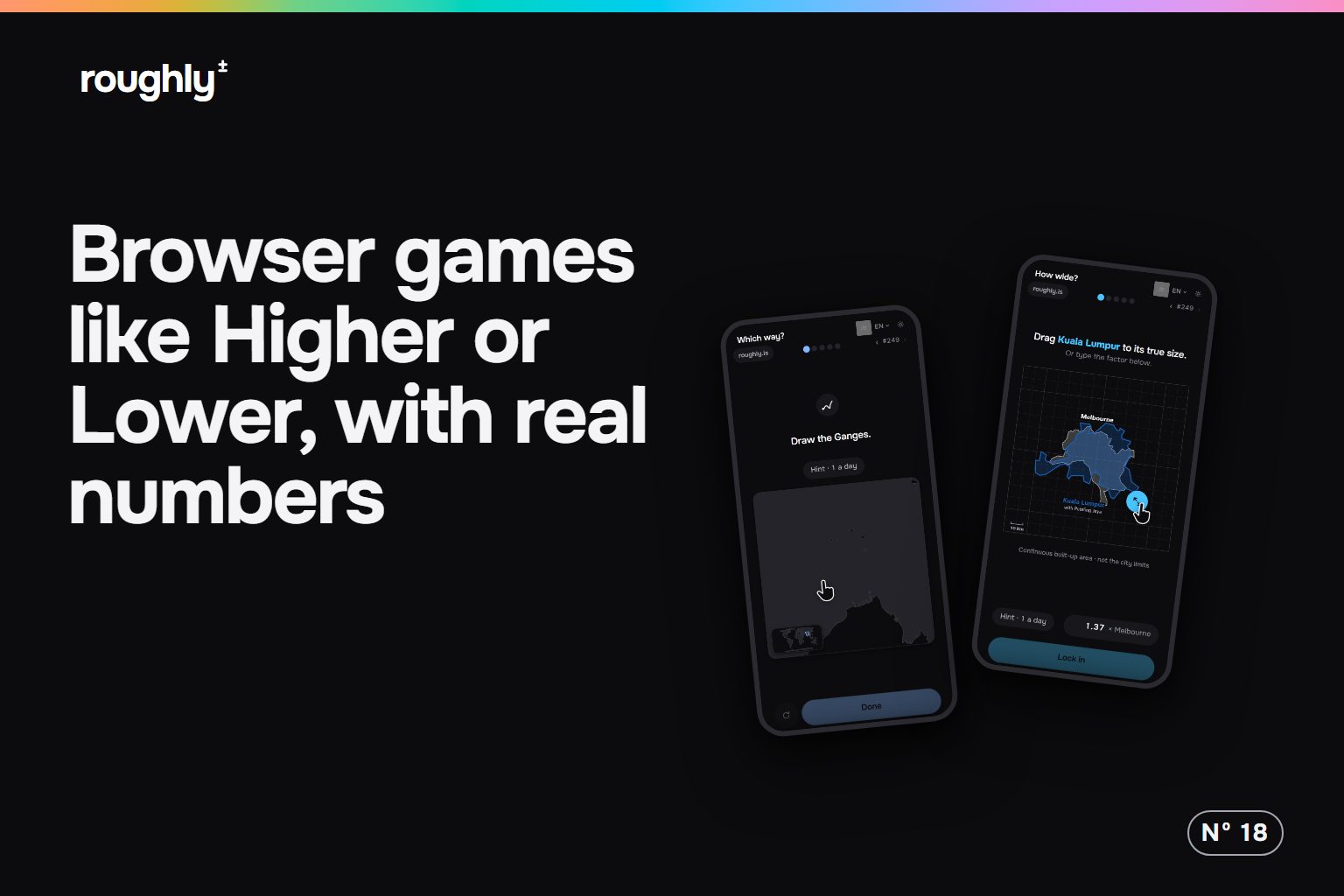
Higher or Lower is fun because it is fast. Two things, one tap, next pair. But a right answer can hide a bad sense of size, because the question only asks for a side. On a two-button question, a random tap is right half the time. A guess with a number on it has nowhere to hide.
A factor shows how wrong you were, a binary answer hides it
On roughly's price game, the misses on today's prices go both ways. The misses on old prices do not.
percent of misses on old prices were too high
1,022 too high and 360 too low on 33 historical items, against an even split on today's prices.
Quelle: roughly blog, old pricesThat means the error has a direction, and only a number can show it. An 800 g loaf of white bread cost 1.9 pence in Britain in 1948. Of 114 players who guessed it, 93 went too high, most by five times or more. Asked "was it more or less than a pound?", nearly all of them would have been right, and none of them would have learned that the loaf was five times cheaper than they thought.
Two things side by side still works, if you size one of them
The comparison is the good part of Higher or Lower. Keep it, and replace the button with a pull.
| Game | What you set | The miss reads as |
|---|---|---|
| How big? | a size, next to a named, fixed object | a factor: 2.5x too small |
| How expensive? | a price, with the place and the year | a factor: 30x too high |
| How likely? | the odds of a real event, as 1 in N | a factor: 10x too common |
| How many? | how many of you fit into a famous thing | a factor with direction: 2.25x too low |
| Who? | the share of people who said yes in a survey | percentage points |
That is why How big? is the closest relative: two shapes stand side by side, the left one is your ruler, and you pull the right one until it looks right. On one day it asked players to size the Hindenburg next to a 4.5 metre Greenland shark. The airship was 245 m long. The typical guess was 46 m, and 181 of 184 players made it too short. Asked only whether the airship was longer than the shark, the typical player would have been right. That is the gap between a side and a size, in one round of data.
Setting the number sounds harder, and nobody is expected to know it
The fair objection: Higher or Lower is easy to start because you never need the number. Nobody knows what a pint of milk cost in 1914.
Nobody has to. The scale is a drag, not a sum, and a guess within about five percent counts as spot on. Then the reveal hands you the way there. A pint read 65 p in January 2025, and British prices are about 162 times their 1914 level, so divide and you land near 0.4 p. The real figure was 0.70 p. The next old price starts from that chain, not from a feeling.
For a loud room, two buttons are faster
With a crowd shouting at one screen, Higher or Lower's two buttons win on speed. A number needs a few seconds of thought, and that is the whole point of it.
So keep both. Play Higher or Lower for the noise, and play one number game a day for the sense of size it builds. The games like Wordle but not words list has more dailies where the answer is a quantity, and the about page explains where every number comes from.
One price a day, set by you, then the real one and its source.
Play today's How expensive?Sources 6
- The Higher Lower Game - "Which gets Googled more? A simple game of higher or lower."
- How much did bread cost in 1948? - the bread guesses and the split between too high and too low
- UK Office for National Statistics, consumer price indices - average retail prices behind the British items
- How big was the Hindenburg? - the Hindenburg round next to the Greenland shark
- How expensive? on roughly - the pint of milk method, scoring as a factor
- How big? on roughly - two shapes side by side, the left one as the ruler